Alex Jones Talks With Alexander Dugin : The World Has Just Witnessed The 2nd American Revolution & That The Globalist System Has Been Defeated






Alexander Dugin describes the Riyadh negotiations as a significant breakthrough, highlighting that the new American administration’s openness has allowed Russia to clearly present its stance on Ukraine, ultimately leading to the political elimination of Zelensky.

Alexander Dugin asserts that any discussion of Ukraine is futile unless it is grounded in a clear understanding of the ideological revolution reshaping global politics and the new world order pursued by Vladimir Putin and Donald Trump.
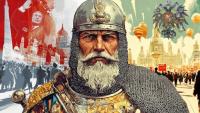
Alexander Dugin argues that the Russian people have been kept in a state of deep ideological slumber by both historical inertia and a ruling elite that fears their awakening, and only a profound national revival — akin to breaking a dark magical spell — can restore their agency and ensure Russia’s survival.

It is remarkable that President Putin and President Trump have finally spoken over the phone. This is a true breakthrough because the leaders of two great powers have initiated a dialogue. Naturally, the issues they discussed pertained to the global order. It is not fitting for the leaders of two great powers to speak of minor matters without first defining new parameters for the world order.

Alexander Dugin emphasizes that Trump’s rejection of liberal globalism and pursuit of American hegemony inadvertently paves the way for a multipolar world of sovereign great powers.

Alexander Dugin highlights Putin’s 2007 Munich speech as the beginning of a multipolar revolution challenging unipolar globalism and diminishing the relevance of the UN.

Alexander Dugin argues that the “New Yalta” will be marked by key negotiations among major civilizational powers like Russia, the West, China, and India, ultimately leading to the creation of a multipolar world order beyond Western dominance.

In an instant, following Trump's rapid reforms, where he declared that there are only two genders—male and female—a monstrous picture unfolded before the eyes of Americans and the entire world. Millions of those who had been convinced by the previously ruling liberals to change their gender or identify as non-existent genders suddenly found themselves transformed from "progressive", "forward-thinking" citizens into cripples, invalids. Just moments before, they had been inculcated with the idea that gender diversification, including castration, mutilation, and the psychological breakdown of young children, were signs of "the most adequate social behavior".

The US president won’t go back to politics as usual. Through his Trumpist ideology, he could spearhead a sociopolitical revolution—both at home and abroad.

The liquidation of the United States Agency for International Development (USAID) is an event whose significance can hardly be overstated. When the Soviet Union abolished the Comintern (Third International) and later the Cominform, structures that advocated the ideological interests of the USSR on a global scale, it marked the beginning of the end for the international Soviet system.
The Fourth Political Theory for Nepal is a synthesis of democratic, monarchic, and socialist principles, recalibrated to fit Nepal’s unique context.
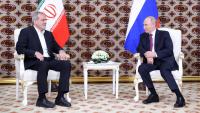
It is worth paying attention to the fact that the Treaty refers to a comprehensive partnership. This indicates that there are many non-public elements in addition to those points and articles that are openly stated and signed by Russian and Iranian Presidents Vladimir Putin and Massoud Pezeshkian following their talks in the Kremlin.
Alexander Dugin argues that Russia must overcome the dictatorship of mediocrity in its cultural sphere to establish a distinct, civilizational cinema and reclaim its unique cultural identity in a multipolar world.
What has transpired in the United States following Donald Trump’s victory in the presidential elections, the inauguration process, and the transfer of power, demonstrates that we are witnessing a rapid process of conservative revolution in the U.S. The system of values is changing in a direction almost diametrically opposed to its previous trajectory. The principles Trump and his team are proclaiming, along with the initial steps they are taking, stand in complete contradiction to the left-liberal ideology underpinning the orientations, strategies, and actions of the globalists.

Currently, everyone in Russia and across the world is clearly puzzled about what is happening in the United States. President-elect Donald Trump and his close associates, particularly the passionate Elon Musk, have launched an almost revolutionary level of activity. Although Trump has not yet assumed office — this will happen on January 20 — America and Europe are already shaking. This is an ideological and geopolitical tsunami that, frankly, no one anticipated. Many expected that after being elected, Trump — much like during his first term — would revert to a more or less conventional policy, albeit with his charismatic and spontaneous traits. It can now be said with certainty: this is not the case. Trump is a revolution.

Alexander Dugin discusses the illegitimate regime in Ukraine, the crumbling globalist order, and the rise of a new ideological confrontation between the Trumpist West and the traditionalist multipolar world.

Alexander Dugin opposes liberal racism and globalist homogenization, emphasizing the richness of collective ethnic and cultural identities.
Rejecting 20th-century totalitarian frameworks, Alexander Dugin calls for ideological clarity and fair debate in a multipolar world led by genuine freedom of speech.

Alexander Dugin reflects on the passing of Jean-Marie Le Pen, praising the steadfast right-wing leader’s lifelong resistance against liberal globalism.

The trumpism in IR is reorganisation of Western hegemony on the basis of right liberalism and Western identity.

Alexander Dugin’s text contrasts two opposing forces within the West: the globalist "Monster-West," represented by liberal elites and their network of influence, and the "MAGA-West".

Alexander Dugin integrates Freudian, Jungian, and Guattarian frameworks to analyze civilizations as dynamic systems shaped by unconscious structures, material flows, and rationalized universes, offering a critique of Western modernity and envisioning multipolarity as a reterritorialized civilizational order.

Firstly, I believe in our people, I believe in our State, I believe in Russian history. This war is not an accident. Maybe it is the most important and the most sacred war of our history, which we are now waging with the West on the territory of Ukraine

What the life after woke looks like? If we want to overcome woke, we need to identify its roots and extract them. The roots are nominalism, hyper-individualism and liberalism as ideology...

Alexander Dugin argues that the nation’s sovereign heart calls for crushing liberalism while unleashing the creative and patriotic spirit of the Russian people to affirm their imperial destiny.

The Strauss-Howe theory is particularly relevant when addressing the dynamic between sociality (holism) and individualism. This is akin to the famous L. Dumont's dilemma where sociality represents the High, the beginning, and spring, while individualism signifies the Crisis, the end, and winter, with the individual portrayed as Krampus.

Richard Malcolm Weaver, Jr. was an American scholar known for his contributions to conservative thought. Here are some key ideas associated with him..

A profound shift in the global perception of Israel — and perhaps of the Jewish people as a whole — is underway. After the catastrophe European Jews endured under Hitler during World War Two, they evoked widespread pity, compassion, and sincere sympathy on a global scale. This moral capital facilitated the establishment of the State of Israel. The Holocaust, or Shoah — signifying the horrors and persecutions suffered by Jews — served as the foundation for the universal consensus: after such suffering, the Jewish people unquestionably deserved their own state. This sacred status of the Holocaust became a cornerstone of Jewish identity and moral capital.

In this text, Alexander Dugin explores the concept of horror, drawing from Heidegger's distinction between fear (external and explained) and horror (internal and undefined).

How reconcile multipolarity with trumpism? It is not clear yet. Among trumpists there are those who can agree with that and those who are against. Neocons don’t take part in trumpism directly (being globalists) but their influence is still present.

There are situations where the predictions and plans made beforehand realise in the field of facts. Then you can follow them comparing and reality check is backed by the correlation with forecast: this is correct, that is wrong, that is deviation.
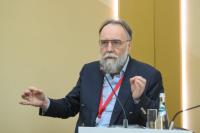
Alexander Dugin argues that the unfolding chaos of 2025 lies in the triadic uncertainty of a dying unipolarity, the theoretical opacity of multipolarity, and the unpredictable conservatism of Trumpism, all converging to demand a new ontology of global order.
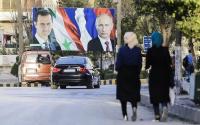
How Syria became the weakest link in a broader plan to undermine Russia's influence? How the globalists' intricate maneuvers to reshape the Middle East, and What's the implications for a multipolar world? Alexander Dugin, speculated as “the Brain of Putin” explores the devastating consequences of the conflict.
What is post-liberalism? There is conventional left version: Wallerstein, Trotskyism, Negri-Hardt global anarchism. Cultural Marxism and hyperglobalization. It is obvious that J.D.Vance, Thiel, Musk and other trump-futurists mean something quite different when they use the term.
So post-liberal right. What does it mean? Easiest way to decipher the notion is to reduce it to previous - more conservative, less progressist, pre-woke - stage of the same liberalism. I guess the majority of Trump's voters instinctively interpret that like this.
Before Trump took office, chaos and unrest seemed to loom. What impact will his presidency have on China and the world?

In August 2022, a car bomb in Moscow claimed the life of Daria Dugina, a rising voice in political philosophy whose insights were cut tragically short at age 29. Her posthumously published work A Theory of Europe stands as both her intellectual testament and a rare window into the French Nouvelle Droite (New Right) movement. While mainstream coverage often reduces this school of thought to simplistic labels, Dugina’s intimate knowledge of its key thinkers reveals a fascinating philosophical current that challenges our fundamental assumptions about European identity and civilization.

Alexander Dugin argues that the collapse of the unipolar world signals the beginning of a grand metamorphosis, as the fading light of Western liberalism gives way to the awakening of ancient traditions, deep civilizational identities, and the promise of a vibrant, multipolar era full of boundless possibilities.

Kathmandu (Keshav Bhattarai): On November 23, 2024, with the support of the Russian House in Nepal, a conference by philosopher and political scientist Alexander Dugin was held at the Russian House in Kathmandu on the theme “Emerging Multipolarity: South Asian Context”.
In this insightful discussion with COGGS, acclaimed Russian political philosopher Alexander Dugin shares his perspective on the Global South and its significance. Explore Russia's views on the Global South, the traditional values that shape this region, and the contrasting dynamics between the West and the Rest of the world.
Africa stands at the crossroads of a changing global order, moving beyond the shadow of Western dominance to claim its rightful place as a powerful and independent force. Professor Aleksandr Dugin explores how Africa can unite, decolonize its mindsets, and lead in a multipolar world while overcoming centuries of exploitation and shaping a future rooted in sovereignty, cultural pride, and economic strength.
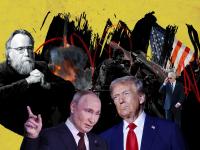
In an exclusive interview with Al Majalla, the Russian political philosopher explains his country's pivot to the Global South and why nothing will change Moscow's edge on the Ukrainian battlefield
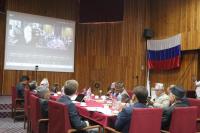
Kathmandu (Keshav Bhattarai): On November 23, 2024, with the support of the Russian House in Nepal, a conference by philosopher and political scientist Alexander Dugin was held at the Russian House in Kathmandu on the theme “Emerging Multipolarity: South Asian Context”(Зарождающаяся многополярность: южноазиатский контекст). The conference gathered numerous distinguished guests, including ambassadors, scholars, and former ministers. At the very beginning of the event, the broadcast was targeted by hackers who disrupted the live stream with obscene content. But, technical issues were promptly resolved.