The concept of the poor subject

A characteristic feature of Russian philosophy, according to some historians of Russian philosophy, is the ontologism of thought. The position of ontologism in philosophy, unlike the opposite position of gnoseologism, implies the primary consideration not of the process of thinking, but of the object of understanding. Being on the side of the ontological, we seek first and foremost to identify and answer the question: WHAT is, WHAT is the object of our knowledge, WHAT is the focus of our intellectual intuition. Adherents of the ontological model seek, first of all, to find among all that 'flows and changes' a certain fundamental point, a fixed point, like a large stone in a fast-flowing mountain river.
The novel Laurus as a manifesto of Russian traditionalism

The novel-life, a 'non-historical novel' as the author Evgeny Vodolazkin (doctor of philology, specialist in ancient Russian literature) calls it, is a description of the destiny and inner development of Arseny the healer. After receiving medical training from his grandfather Christopher, Arseny enters life with all its complexities, temptations and trials. From the beginning, Arseny's profile betrays a man called in spirit and marked by a special gift, an unusual charisma. He is mobilised by a higher power to serve people. He is not of this world, but he serves people of this world. Already in this we can see the plot of suffering and pain.

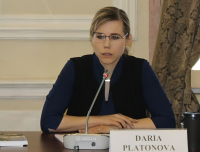
Darya Dugina at the 16th International Conference “The Universe of Platonic Thought”

Political philosophy has always been denied full recognition, focusing on analyzing the metaphysical aspects of Neoplatonism. Neoplatonic concepts such as “permanence” (μονή), “emanation” (πρόοδος), “return” (ὲπιστροφή), etc. were treated in historical-philosophical works separately from the sphere of the Political. Thus, the Political was interpreted only as a stage of ascent toward the Good, embedded in the rigid hierarchical model of Neoplatonic philosophical thought, but not as an independent pole of the philosophical model.

The Fog of Diplomacy and the Civilization-State

On the Escalation show of Radio Sputnik, Alexander Dugin suggests that the “fog of diplomacy” in ongoing US-Russia negotiations over Ukraine conceals a far grander and deeper process: as Trump seeks to withdraw the US from conflict with Russia to focus elsewhere, Russia is emerging as a full-fledged civilization-state focused on spiritual valor and the restoration of its historic ethnic identity.

Sovereign Internet or Digital Isolation? Rethinking Russia’s Online Future

Discussions about the possibility of Russia being disconnected from the global internet are becoming increasingly frequent. Against this backdrop, the question of creating an autonomous Russian internet gains new urgency. How likely is such a scenario, and what would it mean for the average Russian internet user? Could such a step strengthen our country’s sovereignty, or would it, on the contrary, divide society and confine Russia to a kind of virtual solitude?


Guy Debord is Dead

Alexander Dugin recalls the legacy of Guy Debord, one of the last great European non-conformists and the unmasker of the “society of the spectacle,” whose radical critique of modern mass culture, although co-opted by the very System he attacked, might still inspire revolutionary action anew.

Pages